Mathematical Underpinnings of Symbol Clustering Protocols in Certified Electronic Gaming Frameworks
Written by Viktor Walter · Aug 27, 2026
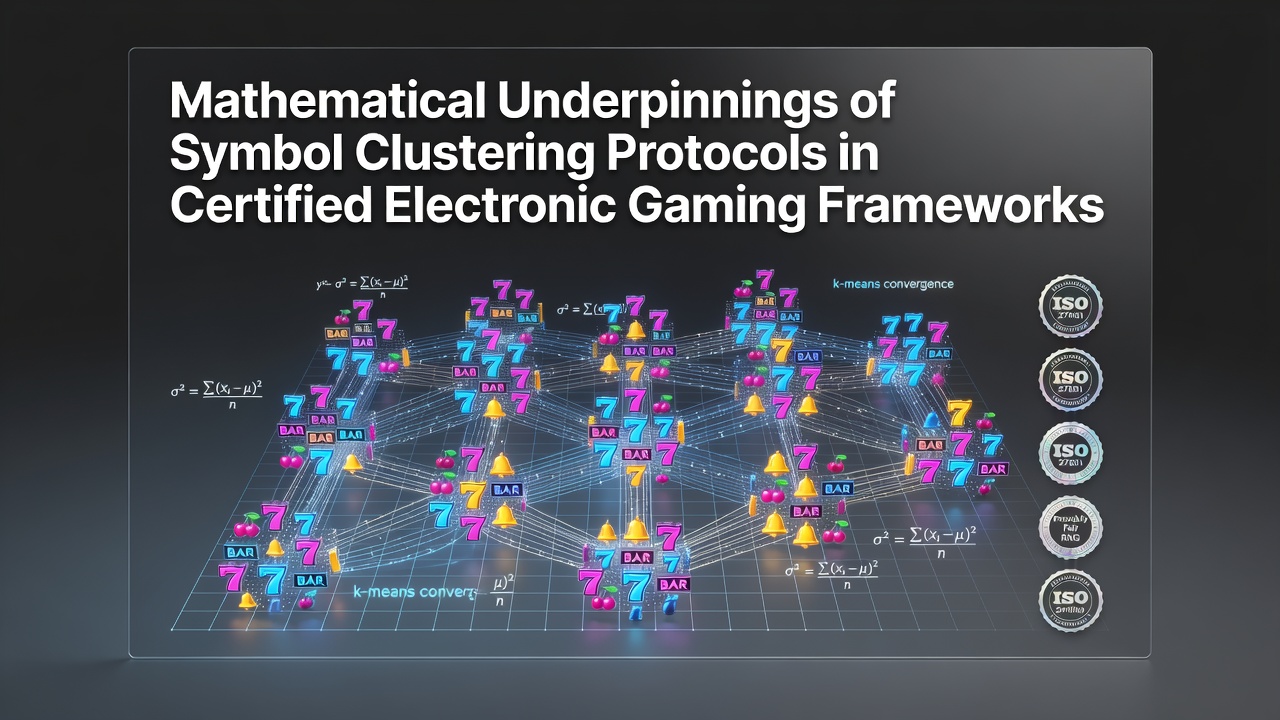
Mathematical Underpinnings of Symbol Clustering Protocols in Certified Electronic Gaming Frameworks
Symbol clustering protocols form a core component of modern electronic gaming frameworks where adjacent matching symbols trigger payouts instead of traditional payline alignments, and these systems rely on precise mathematical structures to maintain fairness and predictability across certified platforms. Researchers in computational gaming mathematics apply graph theory and combinatorial enumeration to define how symbols aggregate on virtual reels, while regulatory frameworks demand verifiable randomness and reproducible outcomes that align with established probability distributions.
Core Mathematical Structures
Clustering mechanics operate through adjacency matrices that map reel positions into connected components, and analysts calculate win probabilities using binomial coefficients combined with position-weighted distributions that account for both symbol frequency and spatial relationships. These calculations incorporate Markov chains to model state transitions between spins, whereas cluster formation follows rules derived from percolation theory that determine the threshold at which isolated symbols merge into qualifying groups. Data from independent testing laboratories shows that such models produce expected return percentages within narrow confidence intervals when seed values and reel strips undergo rigorous verification.
Algorithmic Implementation
Developers encode clustering logic using recursive flood-fill algorithms that scan the grid after each spin outcome, and these routines assign values based on cluster size multipliers drawn from predefined lookup tables calibrated against total symbol combinations. Engineers integrate pseudo-random number generators compliant with standards from the Nevada Gaming Control Board to populate reel strips before applying adjacency checks, which ensures that clustering events remain statistically independent across sequential plays. Observers note that August 2026 updates to certification protocols introduced enhanced requirements for documenting these recursive processes in source code audits.
Certification and Verification Processes
Accredited laboratories evaluate symbol clustering implementations through millions of simulated spins that compare observed cluster frequencies against theoretical predictions derived from combinatorial formulas, and any deviation beyond established tolerance levels triggers code review and reel strip recalibration. The Gaming Laboratories International publishes guidelines that specify test parameters for adjacency-based mechanics, including minimum sample sizes and entropy measurements that confirm uniform distribution across the outcome space. Those responsible for framework certification examine both the random number generation layer and the post-generation clustering logic to prevent unintended bias in payout patterns.

Advanced Probability Modeling
Statistical models for cluster protocols frequently employ generating functions to enumerate all possible cluster configurations on grids of varying dimensions, while Monte Carlo methods validate analytical results by running extensive trial sequences that mirror live deployment conditions. Analysts apply variance reduction techniques such as importance sampling when rare large-cluster events dominate the tail of the payout distribution, and these approaches allow precise estimation of hit frequencies without exhaustive enumeration of every reel combination. Research institutions continue to refine these models as grid sizes increase in newer game architectures released through 2026.
Integration with Broader Game Mathematics
Symbol clustering protocols interact with other mathematical elements including multiplier ladders and bonus round triggers, and designers balance these components so that the overall game mathematics remains within approved return-to-player ranges. Combinatorial analysis extends to multi-symbol interactions where overlapping clusters receive additive or multiplicative treatment according to documented rules, and verification teams confirm that these interactions do not introduce exploitable correlations between successive game states. Regulatory documentation requires full disclosure of all interaction terms within the submitted mathematical reports.
Conclusion
Mathematical frameworks governing symbol clustering continue to evolve alongside advances in algorithmic efficiency and regulatory expectations, and certification bodies maintain strict oversight to preserve integrity across all certified electronic gaming environments. Continued collaboration between mathematicians, software engineers, and testing authorities supports the development of transparent, auditable systems that deliver consistent outcomes based on established probability principles.